Quarry
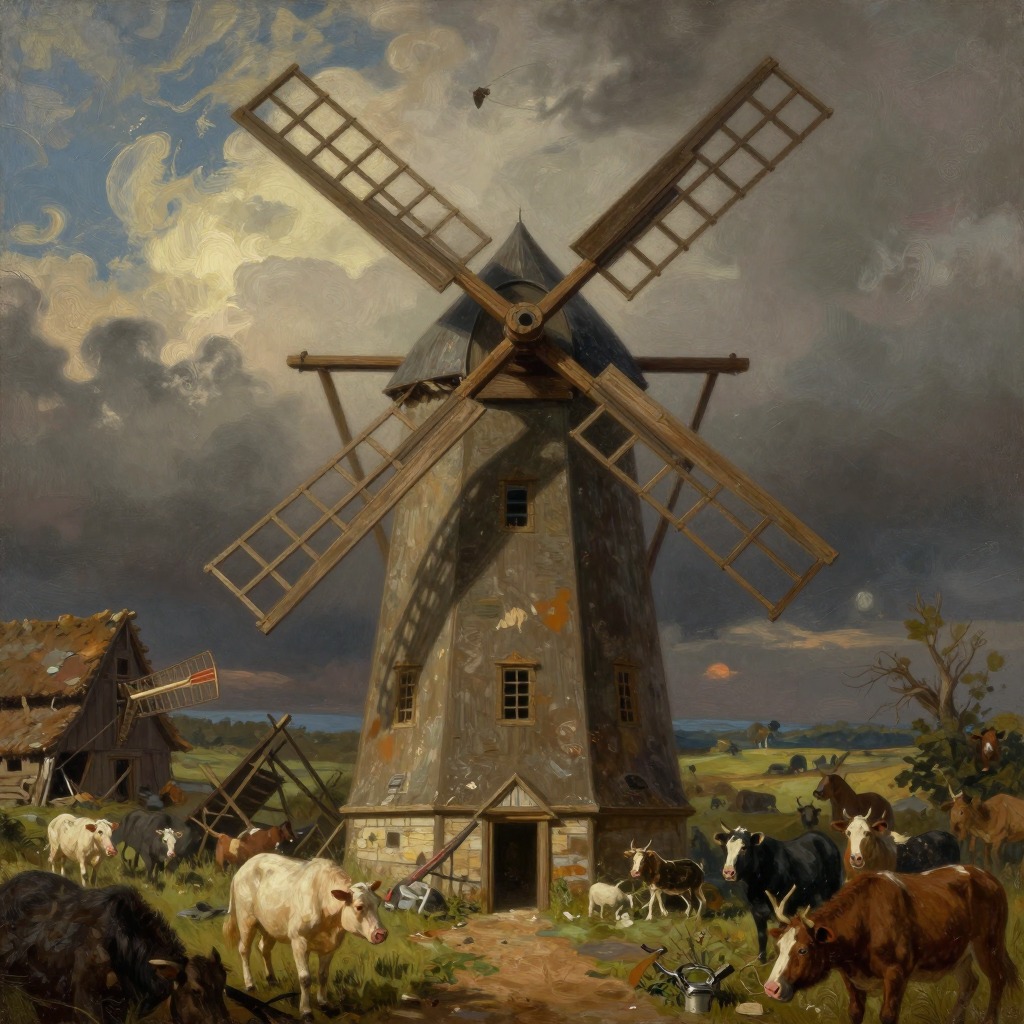
The Quarry on Animal Farm is the central site of the animals' most grueling labor, the source of the stone that built the windmill, and the location where Boxer's final, fatal collapse occurs. It is a place where the ideals of collective work for a common good are transformed into a system of relentless, self-sacrificing toil that ultimately serves the pigs' authority rather than the animals' liberation.
Location and Physical Character
The Quarry is a limestone quarry located on the farm itself. It provides all the necessary stone for the windmill, with sand and cement also found in an outhouse, making the materials for building readily available. The quarry's bed is littered with huge boulders, far too large to be used as they are, which must be broken into smaller pieces. The animals initially cannot solve the problem of how to break the stone, as they cannot use picks and crowbars, which require standing on hind legs. After weeks of vain effort, they devise a method using gravity: they lash ropes around the boulders and, with all the animals—cows, horses, sheep, and even pigs at critical moments—dragging them with desperate slowness up the slope to the top of the quarry, where they are toppled over the edge to shatter below. Transporting the broken stone is comparatively simple, with horses carrying cart-loads, sheep dragging single blocks, and even Muriel and Benjamin yoking themselves into an old governess-cart to do their share.
Labor and Exhaustion at the Quarry
The work at the quarry is slow, laborious, and exhausting. Frequently, it takes a whole day of effort to drag a single boulder to the top, and sometimes when it is pushed over the edge, it fails to break. The quarry is the scene of the animals' most extreme physical exertion, especially for Boxer, whose strength seems equal to that of all the other animals put together. When a boulder begins to slip and the animals cry out in despair at being dragged down the hill, it is always Boxer who strains himself against the rope and brings the boulder to a stop. The sight of him toiling up the slope inch by inch, his breath coming fast, the tips of his hoofs clawing at the ground, and his great sides matted with sweat, fills everyone with admiration. In his spare moments, of which there are not many, Boxer goes alone to the quarry, collects a load of broken stone, and drags it down to the windmill site unassisted. After the executions, when the other animals are shaken and miserable, Boxer moves off at his lumbering trot to the quarry, collects two successive loads of stone, and drags them down to the windmill before retiring for the night. The quarry is also where the effects of the harsh winter are felt most acutely; for a long time, it is full of snowdrifts, and nothing can be done. The work in the dry frosty weather that follows is described as cruel work.
Boxer's Collapse and the Quarry's Narrative Significance
The quarry is the site of Boxer's final, fatal collapse. Late one summer evening, he goes out alone to drag a load of stone down to the windmill. The rumour of his fall spreads rapidly, and the animals find him lying on his side between the shafts of the cart, his neck stretched out, unable even to raise his head, his eyes glazed, his sides matted with sweat, and a thin stream of blood trickling from his mouth. He tells Clover that it is his lung, and that he had only another month to go before his retirement. The quarry thus becomes the place where the cost of the regime's relentless demands is made visible in the body of its most loyal worker. The quarry's stone, which was to build the animals' future, is the very material that breaks their strongest comrade. The quarry is also a place of memory and comparison. In the final years, the older animals rack their dim memories and try to determine whether things had been better or worse than now, but they have nothing to go upon except Squealer's lists of figures. The quarry, as the site of their most tangible and painful labor, stands as a silent, physical record of their sacrifice, a record that the pigs' propaganda can always overwrite.